


# Legal Document Delivery Optimization: A 2026 Playbook
> TL;DR: Legal document delivery optimization means replacing manual routing and spreadsheet dispatch with software built around court deadlines, multi-attempt tracking, and defensible proof of service. Agencies running 10+ servers typically lose $5,000+ a month to inefficient routing and dispatcher rework. Zeo Route Planner addresses this with priority stops for deadline-driven serves and field-level photo, signature, and GPS capture, giving process serving agencies evidence that syncs back to the office in real time.
If you run a process serving agency, you already know the stakes. Miss a court deadline and your client’s case gets delayed or dismissed. Show up with weak proof of service and the whole serve can get challenged. Manual routing and spreadsheet dispatch make both problems worse.
Legal document delivery optimization isn’t just about saving gas money. It’s about building a system that protects your agency from missed deadlines, sloppy documentation, and dispatchers drowning in re-attempts. This guide walks through exactly how to fix it.
Why Process Serving Routes Break Standard Delivery Logic (Deadlines, Attempts, and Evidentiary Requirements)
Most route planning tools are built for delivery trucks dropping off packages. Process serving doesn’t work that way.
A package doesn’t care what time it arrives. A defendant does. Many jurisdictions require service attempts at different times of day, sometimes on different days, to show you made a genuine effort to serve someone. Courts in states like California and New York often expect multiple attempts before allowing substitute service or publication, and the specific rules vary by county.
Standard delivery routing also assumes one attempt equals one completed stop. Process serving rarely works that way. A single address might need three, four, or five attempts before it’s marked served, refused, or eligible for alternative service. Each attempt has its own legal weight and needs its own documented evidence.
Then there’s the deadline pressure. Court-ordered deadlines aren’t flexible like a customer’s delivery window. If you miss a statute of limitations deadline for service, the case can be thrown out. Dispatchers juggling 15 servers across multiple counties, each with different attempt histories and different court deadlines, can’t manage this safely in a spreadsheet.
This is why legal document delivery optimization requires software built around attempts, deadlines, and evidence, not just distance and traffic.
What Defensible Proof of Service Actually Requires: GPS, Timestamps, Photos, and Signatures
An affidavit of service is only as strong as the evidence behind it. Opposing counsel routinely challenges service claims, especially in contested divorces, eviction cases, and debt collection suits. According to National Center for State Courts research on default judgments, improper service is one of the most common grounds for default judgments being vacated.
A defensible proof of service typically needs:
- GPS location data confirming the server was physically at the address
- Timestamped records of exactly when each attempt occurred
- Photo evidence of the property, posted notice, or recipient when applicable
- Signature capture when personal service is completed
- Detailed notes describing what happened at each attempt (no answer, refused service, wrong address, dog on premises)
Paper logs and handwritten field notes fall apart under cross-examination. A server who “recalls” attempting service at 6:47 PM on a Tuesday is far less credible than a system that captured GPS coordinates and a timestamped photo at that exact moment.
Zeo Route Planner’s mobile app gives servers a way to capture photo, signature, and GPS proof at every attempt, directly from the field. That data timestamps automatically and syncs back to the office in real time, so your evidence file builds itself as the server works the route instead of getting reconstructed later from memory. This works alongside driver tracking software that gives dispatchers visibility into where each server has been throughout the day.
Calculate Your Agency’s Wasted Mileage and Dispatcher Hours: A Simple ROI Formula
Most agency owners underestimate how much manual routing actually costs them. Here’s a simple formula to find your number.
Wasted mileage cost:
Take your average miles driven per server per day, subtract what an optimized route would require (typically 15-25% less based on industry routing benchmarks), then multiply by your reimbursement rate or fuel cost per mile.
Example: A server drives 120 miles a day manually routed. An optimized route covering the same stops runs 95 miles. That’s 25 miles saved daily, per server. At $0.67 per mile (the 2026 IRS standard mileage rate), that’s about $16.75 saved per server, per day.
With 10 servers working five days a week, that’s over $4,000 a month in mileage alone.
Wasted dispatcher hours:
Track how long your dispatcher spends each day manually assigning stops, re-routing after missed attempts, and calling servers for status updates. Most agencies report 2-3 hours daily on this alone. Broader labor cost context is available through Bureau of Labor Statistics data on legal support occupations, which tracks wage trends for roles like process servers and legal support staff.
At a $25/hour dispatcher rate, that’s $50-75 in labor cost every single day, just managing logistics manually. Over a month, that’s $1,000-1,500 in dispatcher time that could go toward growing the agency instead.
Add wasted mileage and dispatcher hours together, and most agencies running 10+ servers are losing $5,000+ a month to inefficient routing. That’s before counting the cost of a blown deadline or a challenged affidavit. For a broader look at how routing efficiency translates to bottom-line savings across industries, see these route optimization case studies with real ROI data.
Must-Have Route Optimization Features for Process Serving Agencies (Comparison: Legal-Specific vs. Generic Delivery Tools)
Not all route optimization software fits process serving. Here’s what actually matters, compared to what generic delivery tools offer.
| Feature | Generic Delivery Tools | What Process Serving Needs |
|—|—|—|
| Stop prioritization | First-in-first-out or driver’s choice | Priority stops so servers hit ASAP court deadlines first |
| Time windows | Customer delivery windows | Attempt-based scheduling across different times of day |
| Proof of completion | Signature only | Photo, signature, GPS, and detailed notes per attempt |
| Multi-attempt tracking | Not supported | Attempt history tied to address, with skip-tracing notes |
| Jurisdiction awareness | Not applicable | Routes organized by county/jurisdiction boundaries |
| Dispatcher tools | Basic assignment | Skill-based assignment, dynamic mid-shift reassignment |
Zeo Route Planner covers the core of this list with features built for real operational needs: priority stops for ASAP serves, time window constraints for attempt scheduling, capacity and skill-based driver assignment, and dynamic route adjustments when a server needs to be pulled mid-shift for an urgent serve. Learn more about how proof of delivery capture works across photo, signature, and notes in the field.
The AI-powered optimization engine can save servers 2+ hours daily by cutting drive time between stops, time that goes straight back into completing more attempts instead of sitting in traffic.
Step-by-Step: Configuring Zeo Route Planner for Court-Deadline-Driven Multi-Stop Routes
Here’s how to set this up for your agency.
Step 1: Import your addresses in bulk.
Upload your service list via Excel, CSV, or Google Sheets directly into the Zeo web platform. If you’re managing 20-50 addresses across several counties, this alone saves the manual entry your dispatcher used to do one address at a time.
Optimize routes with our algorithm, reducing travel time and costs efficiently.
increase fuel savings
Save 2 Hours on Deliveries, Everyday!
Step 2: Mark priority stops.
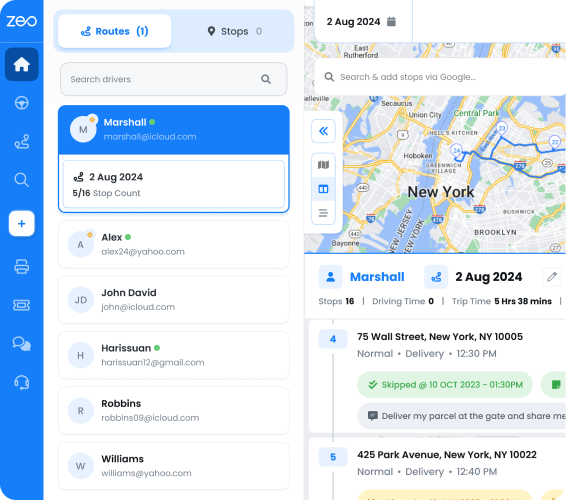
Flag any serve with an approaching court deadline as a priority (ASAP) stop. Zeo’s routing engine will sequence these ahead of standard-priority attempts, so your servers hit the time-sensitive addresses first, not whatever’s geographically closest.
Step 3: Set time windows for attempts.
If a court or jurisdiction requires attempts at varied times (morning, evening, weekend), configure time window constraints for each address. This keeps you compliant with local rules on what counts as a “reasonable attempt” to serve.
Step 4: Assign by skill and territory.
If certain servers are licensed or authorized in specific counties, use skill-based job assignment to make sure the right server gets routed to the right jurisdiction automatically.
Step 5: Dispatch from the web, execute from the app.
Once routes are built, dispatchers assign them from the Zeo web platform with a few clicks. Your servers then receive the route directly on the Zeo mobile app, with turn-by-turn navigation to each address, service instructions, and any attempt history already logged.
Step 6: Capture proof in the field.
At each stop, the server logs the outcome (served, refused, no answer, wrong address), attaches a photo, captures a signature if applicable, and adds skip-tracing notes if the recipient has moved or is avoiding service. GPS and timestamp data attach automatically. This all syncs back to the office in real time, so your case management system reflects the current status the moment the attempt happens, not hours later when the server gets back to the office.
Step 7: Monitor and reassign mid-shift.
If a rush serve comes in or a server falls behind, dispatchers can adjust routes dynamically from the web platform without rebuilding the whole day’s schedule.
This workflow turns a process that used to take a dispatcher hours of manual coordination into a 15-minute setup, with evidence collection built into every step instead of bolted on afterward.
Choosing the Right Setup by Agency Size: Solo Servers, Growing Teams, and Multi-State Operations
Solo servers and owner-operators (1-3 servers):
Focus on the mobile app. You’re both the dispatcher and the server, so you need a tool that lets you build a route quickly in the morning and capture court-ready proof at every stop. Use Favorites for addresses you serve repeatedly, like courthouses or frequent defendant locations, to speed up route building.
Growing agencies (5-15 servers):
This is where the fleet setup matters most. Your dispatcher builds and assigns routes from the Zeo web platform each morning, using priority stops and skill-based assignment to match servers to the right jurisdictions. Servers then get their routes pushed to the Zeo mobile app, where they navigate stop-to-stop and log proof of service without calling the office for updates. Real-time GPS tracking lets your dispatcher see who’s behind schedule and reassign before a deadline gets missed.
Multi-state and multi-jurisdiction operations (15-25+ servers):
At this size, jurisdiction-specific rules become your biggest operational risk. Use skill-based assignment to keep servers within their licensed counties or states, and lean on route analytics to track which regions have the highest re-attempt rates or missed-deadline risk. Branded tracking links and customer notifications also become useful here for keeping law firm clients updated on serve status without your dispatcher fielding constant status-check calls. Agencies handling sensitive paperwork alongside process serving may also find overlap with how financial document delivery routes and security compliance are structured.
Across every size tier, the core principle stays the same: dispatchers plan and assign from the web, servers execute and document from the app, and the two stay connected in real time.
Frequently Asked Questions
Q: How many attempts are required before substitute service is allowed?
Rules vary significantly by state and county, but most jurisdictions require between two and four documented attempts at different times of day before a court will allow substitute service or publication. Always confirm exact requirements with the specific court or jurisdiction, since a California county’s rules may differ from a New York county’s rules even within the same state. Keeping a time-stamped log of each attempt is critical regardless of the exact number required.
Q: What makes a proof of service affidavit hold up in court?
A strong affidavit combines GPS location data, timestamped records, photo evidence, and detailed notes describing exactly what happened at each attempt. Courts and opposing counsel scrutinize vague or reconstructed accounts, so evidence captured in real time in the field carries far more weight than notes written from memory later. Zeo Route Planner’s mobile app captures photo, signature, and GPS data at the moment of each attempt, syncing it back to the office automatically.
Q: How much does manual routing actually cost a process serving agency?
Agencies running 10 or more servers often lose $5,000 or more per month between wasted mileage and dispatcher hours spent manually assigning and re-routing stops. A server driving 25 unnecessary miles a day at current IRS mileage rates adds up quickly across a team, and that’s before factoring in the cost of a missed deadline. Calculating your actual miles-per-server and dispatcher hours spent on manual coordination is the fastest way to see the real number.
Q: Can route optimization software handle different court deadlines for different servers?
Yes, provided the software supports priority-based stop sequencing rather than just distance-based routing. Zeo Route Planner lets dispatchers flag serves with approaching court deadlines as ASAP priority stops, so the routing engine sequences those ahead of standard attempts instead of just optimizing for the shortest path. This matters most for agencies juggling multiple servers across different counties with different filing deadlines.
Q: What’s the difference between routing software for deliveries and software for process serving?
Generic delivery routing tools assume one attempt equals one completed stop and don’t account for varied time-of-day requirements or multi-attempt histories. Process serving needs software that supports priority stops for deadline-driven serves, time window constraints for attempt scheduling, and proof capture that includes photos, signatures, and notes tied to each individual attempt, not just a single delivery confirmation.
Wrapping Up
Legal document delivery optimization comes down to three things: hitting court deadlines, minimizing wasted mileage and dispatcher hours, and capturing proof of service that holds up when it’s challenged. Manual routing and spreadsheets can’t reliably deliver all three at once, especially as your agency grows past a handful of servers.
Zeo Route Planner is used by companies managing exactly this kind of multi-stop, deadline-driven, evidence-heavy routing, across 150+ countries and more than 1.5 million users. The combination of AI-powered route optimization, priority stops, and field-level proof of service capture gives process serving agencies a system built for how this work actually happens, not a generic delivery tool retrofitted for legal use.
Start a free trial of Zeo Route Planner to build your first optimized, compliance-ready serving route in under 15 minutes. Or book a demo to see multi-jurisdiction routing and proof-of-service capture in action.
Are you a fleet owner?
Want to manage your drivers and deliveries easily?
Grow your business effortlessly with Zeo Routes Planner – optimize routes and manage multiple drivers with ease.

increase fuel savings
Save $200 on fuel, Monthly!
Optimize routes with our algorithm, reducing travel time and costs efficiently.
Get Started for Free