

# Equipment Delivery Management: The Complete Guide
> TL;DR: Equipment delivery management requires handling two-way logistics — deliveries and pickups — within tight job-site time windows, unlike standard one-way parcel delivery. Late equipment can idle an entire crew, and the U.S. equipment rental industry now treats logistics as a growing share of operating costs. Route optimization tools like Zeo Route Planner address this with capacity-based routing and time window constraints, helping field service and rental teams save 2+ hours daily on planning.
Equipment deliveries aren’t like shipping a package. You’re moving expensive machinery, tracking pickups and returns, and hitting job-site windows where a late arrival can shut down a crew for hours.
If you’re still coordinating this by phone, spreadsheet, or basic delivery apps, you’re managing risk you don’t need to carry. This guide breaks down equipment delivery management step by step — what it is, how to structure the workflow, and which software features actually solve the problem.
What Is Equipment Delivery Management? (And How It Differs from Standard Delivery Logistics)
Equipment delivery management is the process of scheduling, routing, tracking, and documenting the movement of equipment between a depot, job sites, and customer locations — including both drop-offs and pickups.
It’s a different problem than standard parcel or freight delivery. Here’s why:
Two-way logistics. A courier delivers a package and moves on. An equipment delivery often involves dropping off a generator on Monday and picking it up Friday — sometimes with a swap in between. Your routing has to account for both legs, not just one.
Time-sensitive job-site coordination. A late package is an inconvenience. A late excavator delivery means a construction crew sits idle, billing the general contractor for downtime they didn’t cause. This overlaps closely with construction delivery management, where scheduling precision directly affects crew productivity. Field services research from the U.S. Bureau of Labor Statistics shows equipment rental and heavy machinery sectors depend heavily on tight scheduling windows to keep downstream labor costs in check.
Liability and accountability. Standard delivery software confirms an item arrived. Equipment delivery management needs proof of condition, proof of receipt, and often a signature from someone authorized to accept high-value assets.
Vehicle and capacity constraints. You’re not fitting boxes in a van. You’re matching flatbeds, box trucks, and specialty vehicles to specific equipment dimensions and weights — and making sure the right vehicle is at the right site. Heavy equipment transport also carries site-safety considerations worth reviewing through OSHA’s heavy equipment guidelines.
If your current tools don’t handle all four of these, you’re not doing equipment delivery management. You’re doing generic delivery tracking and hoping nothing goes wrong.
The Key Components Every Equipment Delivery Workflow Needs
A workflow that actually holds up under real operational pressure needs five components:
1. Centralized scheduling. One place to see every drop-off, pickup, and return — not three spreadsheets and a group text.
2. Route optimization by capacity and skill. Routes should factor in vehicle weight/volume limits and which drivers are certified or trained for specific equipment.
3. Time window management. Job sites often have narrow access windows (site opens at 7am, crew leaves at 3pm). Your routing needs to respect that, not just calculate the shortest distance.
4. Proof of delivery and pickup. Proof of delivery — photo documentation, digital signatures, and delivery notes — protects you when a customer disputes equipment condition or claims a pickup never happened.
5. Real-time visibility. Dispatchers and customers both need to know where equipment is, right now — not “should be there by end of day.” This is where driver tracking software closes the gap between dispatch and the field.
Miss any one of these, and you’ll see it show up as missed pickups, billing disputes, or a driver stuck at a locked gate with no way to reach the office.
How Route Optimization Software Solves Equipment Delivery’s Toughest Challenges
Manual scheduling breaks down fast once you’re running more than a handful of vehicles. Here’s where route optimization software directly addresses the pain points unique to equipment delivery.
Two-way stops in one route. Zeo Route Planner’s AI-powered route optimization can sequence delivery and pickup stops together, so a driver dropping off a compressor at Site A can pick up a returned unit at Site B on the same run — no separate dispatch needed.
Capacity-based routing. Instead of manually checking which truck can carry which load, capacity-based routing assigns stops based on each vehicle’s weight and volume limits. This matters when you’re mixing pallet jacks, generators, and scaffolding on the same day.
Time windows that actually get respected. You can set hard time window constraints for job sites with limited access hours, and the system builds routes around them instead of ignoring them.
Priority stops for urgent jobs. When a customer’s equipment breaks down and needs an emergency swap, you can flag that stop as priority (ASAP) so it gets inserted into the day’s route without a full manual rebuild.
Skill-based assignment. If certain drivers are trained to handle specific machinery or have the right certifications, skill-based driver assignment routes those jobs to the right person automatically.
Documentation at the point of delivery. Photo capture, digital signatures, and delivery notes get collected in the app the moment a driver drops off or retrieves equipment — creating a record you can pull up if there’s ever a dispute.
None of this requires hiring more dispatchers. It requires software built for the actual shape of your problem, not generic parcel logistics repackaged for your industry.
Step-by-Step: Building an Efficient Equipment Delivery Workflow
Here’s how to put this into practice, from morning planning to end-of-day reporting.
Optimize routes with our algorithm, reducing travel time and costs efficiently.
increase fuel savings
Save 2 Hours on Deliveries, Everyday!
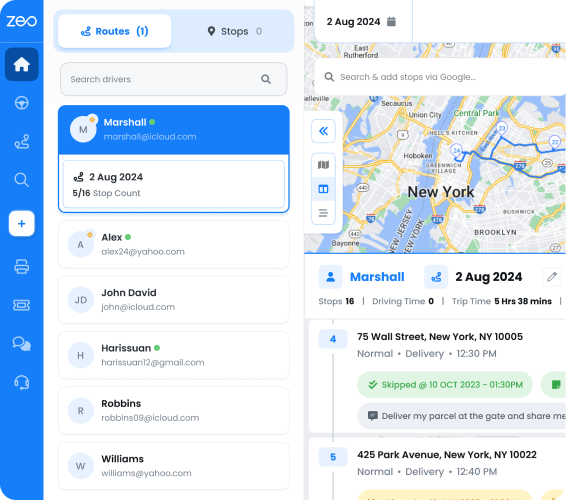
Step 1: Import your day’s jobs. Pull orders in from Shopify or WooCommerce if you’re running online rental bookings, or bulk import addresses from Excel, CSV, or Google Sheets if you’re working off a job list. For recurring drop-offs and returns, set up scheduled/recurring routes so you’re not rebuilding the same run every week.
Step 2: Set constraints before you optimize. Enter vehicle capacity limits, driver skills, and time windows for each stop. This is the step most manual processes skip — and it’s the reason routes fall apart mid-day.
Step 3: Let the software build the route. Zeo’s AI-powered route optimization sequences stops in the most efficient order, factoring in your constraints. Fleet managers running 15-20 vehicles typically save 2+ hours daily on planning alone once this replaces manual scheduling.
Step 4: Assign and dispatch. Once the manager builds and assigns routes on the Zeo web platform, drivers receive their stops instantly on the Zeo mobile app. From there, they navigate using their preferred map app — Google Maps, Waze, or Apple Maps — and see full customer and job details for each stop.
Step 5: Execute and document in the field. At each stop, drivers capture photo proof and collect digital signatures for high-value equipment drop-offs, log details for return pickups, and note any damage or discrepancies. If there’s an issue at the job site — a locked gate, wrong equipment, access problem — drivers message dispatch directly through in-app chat instead of relying on phone tag.
Step 6: Track in real time. Use live GPS tracking to monitor progress across your fleet. Customers get live ETA updates and a branded tracking link, so you’re not fielding “where’s my delivery” calls all afternoon.
Step 7: Review and adjust. If a job runs long or a new urgent order comes in, use dynamic route adjustments to reroute mid-shift without starting from scratch.
This closes the loop between office planning and field execution — the manager plans, the driver executes, and both sides stay connected through the same platform.
Metrics and KPIs That Prove Your Delivery Operation Is Working
You can’t improve what you don’t measure. Track these KPIs monthly, and compare them before and after you implement route optimization:
- On-time delivery rate. Percentage of drop-offs and pickups completed within the scheduled window. This is your single best indicator of job-site reliability.
- Return/pickup completion rate. How often scheduled equipment returns actually happen on the first attempt, without a second trip.
- Miles per stop. Lower miles per stop signals more efficient routing and less wasted fuel. Zeo’s miles tracking feature logs this automatically for expense and tax records.
- Proof of delivery capture rate. What percentage of stops have a photo, signature, or note attached. Gaps here are liability exposure.
- Driver utilization. Stops completed per driver per day, tracked through driver performance analytics.
- Customer disputes per month. Equipment condition or delivery disputes should trend down as documentation improves.
- Average dispatcher time per route. How long it takes to plan and assign a day’s routes — this is the number that shows whether software is actually saving you time.
According to the American Rental Association, the U.S. equipment rental industry generates over $60 billion in annual revenue, with logistics and last-mile delivery cited as a growing share of operating costs. Tracking these KPIs isn’t optional if you want to keep delivery costs from eating into margin as your fleet grows.
How to Choose the Right Equipment Delivery Management Software (Checklist)
Not all route planning tools are built for two-way, high-value equipment logistics. Use this checklist when evaluating platforms:
- ✅ Supports both delivery and pickup stops in the same route — not just one-way parcel drop-offs
- ✅ Capacity-based routing for matching equipment weight/volume to the right vehicle
- ✅ Time window constraints that the system actually respects during optimization
- ✅ Priority stop handling for urgent swaps or emergency equipment needs
- ✅ Skill-based assignment if certain equipment requires trained or certified drivers
- ✅ Proof of delivery tools — photo, signature, and notes, built into the driver app
- ✅ Real-time GPS tracking and live ETA updates for both dispatch and customers
- ✅ Mobile app for drivers separate from the fleet planning dashboard, so drivers get routes without needing office software
- ✅ In-app communication between drivers and dispatch for job-site issues
- ✅ Bulk import and integrations (Shopify, WooCommerce, Zapier, CRM) so you’re not manually re-entering orders
- ✅ Analytics and reporting to track the KPIs above without building your own spreadsheets
If a platform is missing more than one or two of these, it’s likely built for standard parcel delivery — not the two-way, liability-sensitive logistics equipment operations actually need.
Frequently Asked Questions
Q: How far in advance should equipment deliveries be scheduled to avoid job-site delays?
Most equipment rental and construction operations schedule deliveries 24-48 hours ahead to allow time for route planning, vehicle assignment, and confirming site access windows. Same-day changes should still be possible for emergency swaps or breakdowns, which is why priority stop flagging matters for last-minute adjustments. Building in this buffer reduces the chance of a driver arriving before a site opens or after a crew has already left.
Q: What’s the difference between equipment delivery and standard freight delivery?
Standard freight delivery is typically one-way — drop off and move on. Equipment delivery usually involves two-way logistics (delivery and later pickup or swap), tighter job-site time windows, and higher liability since machinery is expensive and often needs documented proof of condition at both ends.
Q: How do you handle equipment pickups and returns without double-booking a truck?
The most reliable approach is centralized scheduling where every drop-off, pickup, and return sits in one system instead of separate spreadsheets or phone logs. Route optimization software like Zeo Route Planner can sequence delivery and pickup stops together in the same route using its AI-powered route optimization, so a driver can drop equipment at one site and collect a return at another without a separate dispatch.
Q: What should a proof of delivery record include for high-value equipment?
At minimum, it should capture a timestamped photo of the equipment’s condition, a digital signature from an authorized recipient, and written notes on any visible damage or discrepancies. This record protects both the rental company and the customer if a dispute arises later about condition or whether a pickup actually happened.
Q: Can route optimization software reduce equipment delivery costs?
Yes — capacity-based routing, time window management, and reduced miles per stop all lower fuel and labor costs by cutting wasted trips and idle time. Zeo Route Planner’s miles tracking feature also logs mileage automatically, which fleet managers can use for expense and tax reporting alongside cost-per-stop analysis.
Getting Started
Equipment delivery management doesn’t have to mean juggling phone calls, spreadsheets, and guesswork about which truck has room for what. The businesses that get this right treat it as a system — scheduling, routing, execution, and documentation working together, not as separate manual tasks.
Start a free trial of Zeo Route Planner to build your first optimized equipment delivery route in minutes. Or book a demo to see fleet dispatch, driver tracking, and proof-of-delivery in action for your specific operation.
Are you a fleet owner?
Want to manage your drivers and deliveries easily?
Grow your business effortlessly with Zeo Routes Planner – optimize routes and manage multiple drivers with ease.

increase fuel savings
Save $200 on fuel, Monthly!
Optimize routes with our algorithm, reducing travel time and costs efficiently.
Get Started for Free