


# Financial Document Delivery: How Route Optimization Closes Compliance Gaps
> TL;DR: Financial document delivery requires verifiable chain-of-custody records and hard deadline compliance, not just fast transit, since a late or unverified handoff can trigger compliance exposure and delayed closings. Route optimization tools like Zeo Route Planner address this with time window constraints, priority stop flagging, and photo/signature proof of delivery, helping courier operations managers save 2+ hours daily compared to manual dispatching.
Financial document delivery isn’t like dropping off a package on a doorstep. When you’re moving loan packages, signed contracts, checks, or notary documents between branches, every stop carries legal and financial weight.
If a document arrives late, goes to the wrong person, or can’t be verified as delivered, you’re not just dealing with an unhappy customer. You’re dealing with compliance exposure.
This guide breaks down what makes financial document delivery different, what it costs you when things go wrong, and how route optimization technology helps operations managers run a tighter, more auditable operation — whether you manage an in-house courier fleet or a third-party dispatch team.
What Is Financial Document Delivery (and Why It’s Different From Standard Courier Work)
Financial document delivery is the transport of sensitive, time-sensitive paperwork between banks, credit unions, title companies, law firms, and their branches or clients. Think loan packages headed to underwriting, signed notary documents going back to a title company, or checks moving branch-to-branch for processing. It shares some operational DNA with legal document delivery, where chain of custody and deadline precision matter just as much as speed.
Standard courier work cares about speed. Financial document delivery cares about speed, chain of custody, and proof.
Every stop needs a verifiable record: who received the document, when, and where. Many deliveries carry strict time windows tied to underwriting deadlines, closing dates, or regulatory cutoffs. Miss the window, and a loan closing can get pushed back or a compliance filing can be late. This is especially true for mobile notary routes, where a single missed window can delay an entire closing.
Add in multiple branches, rotating drivers, and dozens of daily stops, and manual route planning becomes a liability. A dispatcher juggling spreadsheets and phone calls has no reliable way to guarantee a document moved securely from Point A to Point B.
The Real Cost of Getting It Wrong: Compliance Deadlines, Chain-of-Custody Gaps, and Multi-Branch Chaos
Late or unverified financial document delivery has real costs, and they go beyond a frustrated branch manager.
Compliance deadlines. Many financial documents are tied to regulatory timelines. A late-filed notary document or a delayed loan package can trigger penalties, delayed closings, or a compliance review. The Consumer Financial Protection Bureau’s mortgage servicing complaint data has flagged delayed disclosure delivery as a recurring source of complaints in mortgage servicing, underscoring how much scrutiny document timing gets in this industry.
Chain-of-custody gaps. If you can’t prove who handled a document and when, you have a chain-of-custody gap. That’s a problem during an audit, a legal dispute, or a customer complaint. Verbal confirmations and handwritten logs don’t hold up well under scrutiny.
Multi-branch chaos. Once you’re coordinating 5, 15, or 50 drivers across multiple branches, manual dispatching breaks down fast. Drivers double back, routes overlap, and dispatchers lose visibility into who’s carrying what. According to the American Bankers Association’s research on branch operations, branch networks increasingly rely on centralized courier operations to move documents and cash between locations — which means a single routing mistake can ripple across an entire regional network. This dynamic is also reshaping banking logistics more broadly, as institutions consolidate courier operations across growing branch footprints.
The bigger risk is that these problems compound. A late delivery caused by a bad route often means a documentation gap too, since nobody was tracking the delay in real time.
How Route Optimization Technology Guarantees On-Time, Secure Delivery at Scale
Generic courier dispatching wasn’t built for compliance-heavy, time-definite delivery. Route optimization software was.
Zeo Route Planner uses AI-powered route optimization to build the most efficient sequence of stops for every driver, factoring in time windows, priority stops, and driver skills. For financial document delivery, this means a loan package with a 2 PM underwriting deadline gets flagged as a priority stop, not buried in a driver’s route behind lower-urgency drops.
This matters at scale. A courier company running 30 drivers across 12 branches can’t manually recalculate routes every time a new pickup comes in or a driver falls behind. Zeo’s AI-powered routing adjusts dynamically mid-shift, so dispatchers can insert an urgent branch transfer without rebuilding the entire day’s plan.
Time window constraints are especially critical here. Notary documents tied to a closing, or checks that need to reach a branch before the daily deposit cutoff, require delivery within a specific window, not just “sometime today.” Zeo lets dispatchers set hard time windows per stop, so drivers know exactly when a document needs to arrive.
Capacity-based routing also matters for courier fleets moving high volumes of paperwork or secured pouches. Zeo factors vehicle capacity into route planning, preventing overloaded routes that lead to rushed, careless handling of sensitive documents.
The result: fewer missed deadlines, less manual dispatching work, and a system that scales as your branch network grows. Zeo’s AI-powered optimization saves drivers 2+ hours daily compared to manual route planning, time operations managers can redirect toward oversight instead of firefighting.
In-House Courier Fleet vs. Outsourced Delivery: How Route Planning Software Closes the Gap
Financial institutions typically handle document delivery one of two ways: an in-house courier fleet, or an outsourced third-party dispatch team. Each has different weak points, and route planning software closes the gap for both. Some of the same visibility challenges show up in medical courier routes, another industry where time-sensitive, chain-of-custody deliveries depend on real-time tracking rather than end-of-day reports.
In-house fleets give you more control but often lack the technology to manage complexity. A credit union running its own drivers between 10 branches might still be assigning routes verbally or through a shared spreadsheet. That works at 5 stops a day. It doesn’t work at 50.
Zeo’s web platform lets fleet managers plan and assign routes for the entire team from one dashboard, with skill-based assignment ensuring the right driver handles the right run — for example, assigning a bonded, background-checked driver to high-value document transfers.
Outsourced dispatch teams offer flexibility but often mean less visibility. If you’re relying on a third-party courier service, you may not have real-time insight into where a document is at any given moment. That’s a compliance blind spot.
Route planning software closes this gap by giving both models the same infrastructure. Whether drivers are W-2 employees or contracted couriers, they receive optimized routes directly on their phones via the Zeo mobile app, complete with turn-by-turn navigation and stop details. Dispatchers get the same real-time visibility either way.
Optimize routes with our algorithm, reducing travel time and costs efficiently.
increase fuel savings
Hassle Free Deliveries & Pickups!
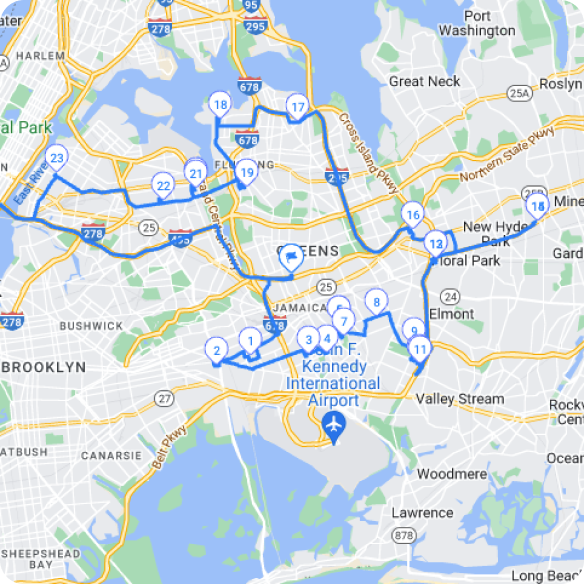
This matters especially for courier companies serving multiple financial clients. A single dispatcher can manage routes for several banks or title companies simultaneously, using Zeo’s bulk address import to load daily pickup and drop-off lists from Excel, CSV, or Google Sheets in minutes instead of manually entering stops one by one.
Proof of Delivery and Real-Time Visibility: Turning Tracking Into Compliance Documentation
For financial document delivery, proof of delivery isn’t a nice-to-have. It’s the backbone of your chain-of-custody record. If you’re unfamiliar with how this works in practice, what proof of delivery actually covers is worth reviewing before building out a compliance process.
Drivers use the Zeo mobile app to capture digital signatures, timestamped photos, and delivery notes at the exact point of handoff. That means when a loan package reaches a branch manager, there’s a time-stamped photo and signature on file, not just a driver’s word that it happened.
This gives compliance teams an actual audit trail. If a bank’s compliance officer needs to confirm when a specific document reached a specific branch, that record is searchable and timestamped, not buried in a driver’s memory or a paper log.
Real-time visibility matters just as much as the after-the-fact record. Dispatchers monitor every stop in real time from the Zeo web platform, seeing exactly where each driver is and which documents are still in transit, a capability that overlaps closely with what driver tracking software is designed to provide across any time-sensitive delivery operation. This holds true whether drivers are direct employees or contracted couriers working under your dispatch.
Customer notifications add another layer of accountability. Branch staff or clients receiving a live tracking link can see an accurate ETA, reducing the “where is it” phone calls that eat up a dispatcher’s day. And because Zeo generates a branded tracking page with your company logo, financial institutions can maintain a consistent, professional experience across every branch touchpoint.
Consider a title company coordinating a same-day document run between three branches for a closing. The dispatcher sets time windows for each stop, assigns the run to a driver via the web platform, and monitors progress live. When the notary documents are handed off, the driver captures a signature and photo through the app. If the closing attorney later asks for confirmation, the compliance team pulls the timestamped record instead of making a phone call and hoping someone remembers.
Best Practices Checklist for Building a Reliable Financial Document Delivery Operation
Use this checklist to evaluate or tighten up your current document delivery operation.
- Set hard time windows for every compliance-sensitive stop. Don’t rely on “morning” or “afternoon” — use specific windows tied to actual deadlines.
- Flag priority stops separately from routine ones. A branch transfer with a same-day deadline should never get buried behind lower-urgency drops.
- Require photo and signature capture at every handoff. This is your chain-of-custody record if a dispute or audit comes up.
- Give dispatchers real-time visibility into every driver, not just end-of-day reports. Delays need to be caught while there’s still time to fix them.
- Use skill-based or credential-based assignment for high-value document runs. Not every driver should carry a loan package or a signed contract.
- Standardize your process across in-house and outsourced drivers. Compliance shouldn’t depend on whether a driver is on payroll or under contract.
- Track performance data over time. Route analytics and driver performance reports help you spot recurring delays before they become a pattern.
- Automate address intake wherever possible. Bulk import from Excel or Google Sheets cuts down manual entry errors on high-volume days.
Financial document delivery has zero tolerance for guesswork. According to Bureau of Labor Statistics data on couriers and messengers, the demand for time-critical courier services continues to grow, making systemized delivery processes more important, not less. The institutions and courier companies that treat it as a serious logistics problem — not just a driving job — are the ones that keep audits clean and clients confident.
Route optimization technology is what separates a courier operation that “usually” gets it right from one that has the systems to prove it, every time.
Frequently Asked Questions
Q: How long should a financial institution keep proof-of-delivery records for document transfers?
Retention requirements vary by document type and regulator, but many banks and credit unions keep chain-of-custody records for as long as the underlying loan or account stays active, often 3-7 years. Digital proof of delivery (timestamped photos, signatures) is easier to store and retrieve than paper logs when auditors request historical records years later.
Q: What’s the difference between a courier tracking number and a chain-of-custody record?
A tracking number tells you a package moved through a system; a chain-of-custody record proves who physically handled a document, when, and where, which matters for legal and compliance purposes. Financial document delivery typically requires the latter, since a dispute over a missed closing deadline or a misplaced notary document needs proof of handoff, not just transit status.
Q: Can route optimization software help with same-day document deadlines like loan closings?
Yes. Zeo Route Planner lets dispatchers set hard time windows and mark stops as priority, so a loan package tied to a 2 PM underwriting deadline gets sequenced ahead of routine drops rather than left to a driver’s discretion. This kind of dynamic, mid-shift route adjustment is what separates same-day closing support from standard courier scheduling.
Q: Do I need a dedicated courier fleet, or can I outsource financial document delivery?
Both models work if you have the right visibility and documentation in place. In-house fleets offer more control over who handles sensitive documents, while outsourced dispatch teams offer flexibility for lower volume; either way, route planning software that gives dispatchers real-time tracking and proof of delivery closes the visibility gap that outsourcing often creates.
Q: How can a bank prove a document was delivered on time if a client disputes it?
The strongest evidence is a timestamped digital record captured at the moment of handoff, not a driver’s recollection or a handwritten log. Zeo’s mobile app lets drivers capture a photo, signature, and delivery notes at each stop, giving compliance teams a searchable record they can pull up immediately instead of investigating after the fact.
—
Start a free trial of Zeo Route Planner to build a compliant, on-time financial document delivery operation, or book a demo to see how banks and courier companies use Zeo to manage multi-branch document runs at scale.
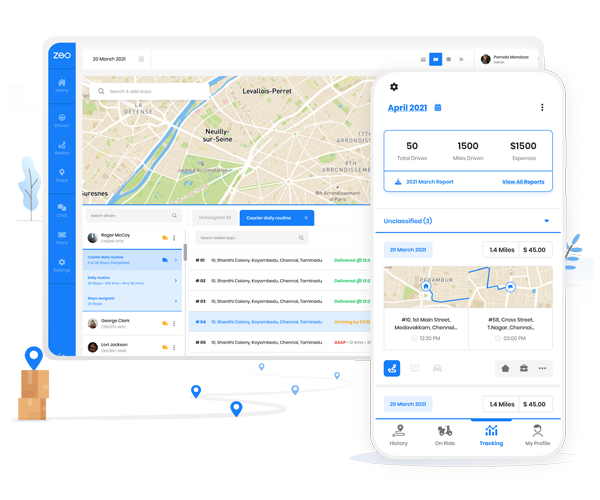
Are you a fleet owner?
Want to manage your drivers and deliveries easily?
Grow your business effortlessly with Zeo Routes Planner – optimize routes and manage multiple drivers with ease.
increase fuel savings
Hassle Free Deliveries & Pickups!
Optimize routes with our algorithm, reducing travel time and costs efficiently.
Get Started for Free