

# The Complete Route Planner Guide: Transform Manual Planning Into Automated Efficiency
> TL;DR: Route planning software transforms chaotic manual processes into streamlined operations by automatically optimizing multiple driver routes in minutes instead of hours. Professional route optimization typically saves 20-30% on fuel costs and reduces planning time from 2-3 hours to 15-20 minutes daily. AI-powered platforms like Zeo Route Planner address these challenges with automated stop assignment and real-time tracking, helping fleet operations save 2+ hours daily.
Manual route planning works fine when you have two drivers and a dozen stops. But as your business grows to 5, 10, or 20 drivers, those morning planning sessions stretch from 30 minutes to 3 hours. Your fuel costs climb, drivers complain about inefficient routes, and you spend your entire morning juggling stops instead of growing your business.
The solution isn’t hiring more office staff or working longer hours. Smart business owners invest in a professional route planner that automates the chaos and gives them back control of their operations.
Why Manual Route Planning Becomes Impossible as Your Business Grows
When you started your business, planning routes was simple. You knew every street, every customer, and every driver’s preferences. A quick glance at addresses on sticky notes was enough to create decent routes.
But growth changes everything. According to the Small Business Administration, delivery and service businesses typically hit their first major operational bottleneck between 8-15 employees. Route planning becomes the daily nightmare that eats your morning and frustrates everyone involved.
The Hidden Costs of Manual Planning
Every hour you spend shuffling papers and checking Google Maps costs your business money. If you’re planning routes for 8 drivers and spending 2 hours each morning, that’s $30-50 in labor costs just for planning. Multiply by 250 working days, and you’re spending $7,500-12,500 annually on route planning alone.
The real damage happens in the field. Manually planned routes typically waste 15-25% more fuel than optimized routes. For a fleet burning 500 gallons monthly, that’s 75-125 gallons wasted. At $3.50 per gallon, you’re throwing away $3,300-5,500 every year.
Driver frustration multiplies these costs. When technicians waste 45 minutes daily driving inefficient routes, they complete fewer jobs and earn less commission. Your best people start looking elsewhere.
When Spreadsheets and Sticky Notes Stop Working
You know manual planning has hit its limit when you experience these daily struggles:
Your morning planning session stretches past 10 AM, delaying first appointments. Customer complaints about late arrivals increase weekly. Drivers call constantly asking for clarification about routes or next stops. You can’t give customers accurate arrival times because you don’t know where drivers actually are.
Emergency calls create chaos because redistributing stops manually takes 30-45 minutes. By the time you’ve replanned routes, the customer is furious and drivers are confused about their new schedules.
Route Planner Types: Basic Apps vs Professional Fleet Solutions vs AI-Powered Platforms
Not all route planners solve the same problems. Understanding the three main categories helps you choose the right tool for your business size and complexity.
Basic Navigation Apps
Free apps like Google Maps or Apple Maps handle simple point-to-point navigation but fall apart for multi-stop planning. Google Maps limits you to 10 stops and doesn’t optimize the sequence. You’re essentially getting digital directions for manually planned routes.
These apps work for solo drivers making 3-5 stops daily. They’re useless for fleet operations where you need to assign multiple routes, track drivers, or communicate with customers.
Professional Fleet Route Planners
Fleet-focused platforms handle the complexity that basic apps ignore. They optimize routes for multiple drivers simultaneously, consider vehicle capacities and time windows, and provide tracking capabilities.
These solutions target businesses with 5+ drivers who need coordination between office planning and field execution. The office team uses web-based platforms to create optimized routes, while drivers receive their assignments through mobile apps.
Professional platforms typically include proof of delivery features, customer notifications, and basic analytics. They solve the operational chaos that kills growing businesses.
AI-Powered Route Optimization
Advanced platforms use AI-powered route optimization to solve complex routing problems that traditional software struggles with. They consider hundreds of variables simultaneously: traffic patterns, driver skills, customer preferences, vehicle restrictions, and real-time conditions.
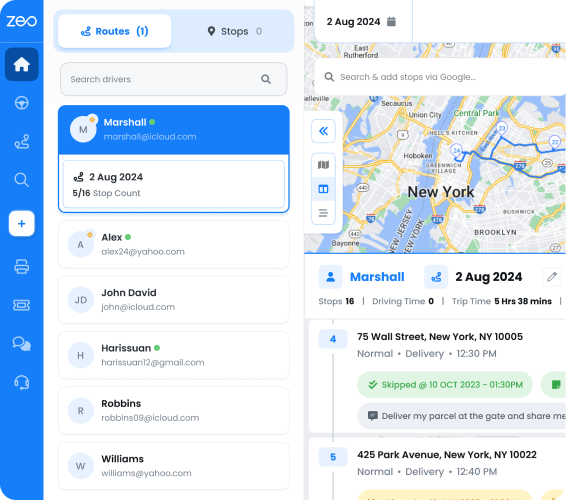
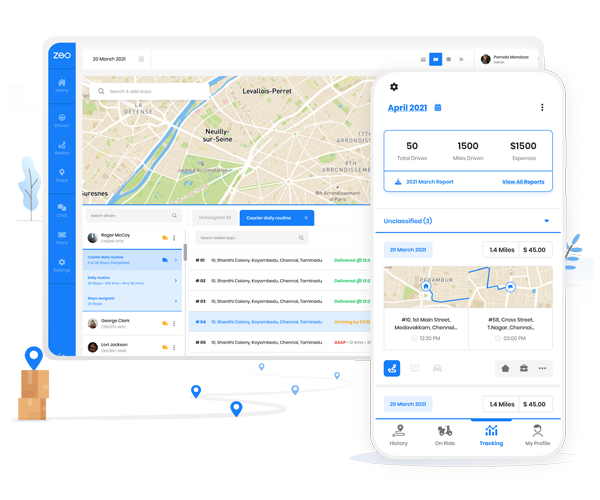
Zeo Route Planner represents this category, using AI to save businesses 2+ hours daily on route planning while serving 1.5M+ users across 150+ countries. The platform automatically assigns stops to drivers based on capacity, skills, and location, then optimizes each route for minimum drive time.
The difference becomes obvious with complex scenarios. When you have 50 stops for 8 drivers with different skills, vehicle sizes, and time constraints, AI finds optimal solutions in seconds that would take humans hours to create.
Essential Features Your Route Planner Must Have (Beyond Just Finding the Shortest Path)
Route optimization is just the foundation. Professional fleet operations need features that connect planning, execution, and customer communication into one seamless system.
Multi-Driver Route Assignment
Your route planner must handle the complexity of multiple drivers simultaneously. Look for automatic assignment capabilities that consider driver skills, vehicle capacities, and current locations.
The best systems let you set up driver profiles with specific skills and equipment. When you import 40 HVAC service calls, the software automatically assigns furnace repairs to certified technicians and simple maintenance to junior staff.
Real-Time Tracking and Communication
Once routes are planned and assigned, you need visibility into execution. Real-time GPS tracking shows exactly where each driver is located, with live ETA updates for customers.
Look for platforms that include customer notifications. Automated SMS and email updates reduce “where’s my driver” calls by 80%. Customers receive tracking links showing their driver’s location and estimated arrival time.
Proof of Service Documentation
Service businesses need evidence that work was completed properly. Essential proof of delivery features include photo capture, digital signatures, and detailed notes.
For example, pool cleaning companies use photos to document before/after conditions and chemical readings. HVAC technicians capture equipment serial numbers and repair details. These records protect against disputes and support insurance claims.
Time Windows and Priority Management
Real customer requirements include specific time preferences and urgent requests. Your route planner must handle delivery windows and priority stops without breaking optimization.
Emergency calls should integrate smoothly with existing routes. When a heating system fails in winter, the software should identify the closest available technician and automatically adjust other appointments.
Capacity and Constraint Management
Different vehicles carry different loads and serve different purposes. Route planners must consider weight limits, volume constraints, and equipment requirements.
Delivery businesses need weight-based optimization for different truck sizes. Service companies need skill-based assignment ensuring certified technicians handle specialized equipment.
Industry-Specific Route Planning Strategies: Delivery vs Field Service vs Sales Teams
Each industry faces unique routing challenges that generic solutions handle poorly. Understanding your specific requirements helps you choose the right approach and features.
Delivery Operations: Volume and Time Pressure
Delivery businesses prioritize speed and capacity utilization. Routes must maximize stops per driver while respecting delivery windows and vehicle limits.
E-commerce deliveries typically involve high stop counts with small packages. Route optimization focuses on minimizing drive time between stops while clustering deliveries in logical neighborhoods. Time windows matter less than efficiency, except for premium services.
Food delivery presents different challenges. Prepared meals require tight time windows to maintain quality. Hot food deliveries need completion within 30-45 minutes of preparation. Route planners must balance order timing with driver availability and location.
Business-to-business deliveries often involve larger items with specific time requirements. Office supply deliveries might specify morning delivery to ensure staff availability for receiving. Industrial deliveries may require coordination with loading dock schedules.
Field Service: Skills and Equipment Complexity
Service businesses face more complex routing because jobs vary dramatically in duration, required skills, and equipment needs. A plumbing company might handle 15-minute faucet repairs and 4-hour sewer line replacements in the same day.
Skill-based routing becomes critical. Pool cleaning companies need certified technicians for chemical balancing but can assign basic cleaning to newer staff. HVAC companies must match furnace installations to experienced technicians while sending apprentices for simple maintenance.
Equipment requirements add another layer of complexity. Pest control companies need different chemicals and tools for residential versus commercial jobs. Electrical contractors require different permits and equipment for residential service calls versus commercial installations.
Zeo Route Planner handles these complexities through skill-based driver assignment and priority scheduling. Managers set up driver profiles with certifications and equipment, then the AI automatically matches jobs to qualified technicians while optimizing routes.
Sales Teams: Relationship and Opportunity Management
Sales route planning balances territory coverage with relationship building and opportunity prioritization. Unlike delivery or service calls, sales visits often involve flexible timing and relationship considerations.
Territory management becomes crucial for sales efficiency. Representatives need logical geographic territories that maximize face time while respecting existing relationships. Route planning should cluster prospects geographically while considering relationship warmth and deal size.
Follow-up scheduling requires different logic than first visits. Hot prospects might need weekly visits regardless of location efficiency, while cold leads get contacted only when geographically convenient.
Sales teams also need integration with CRM systems to automatically sync contact information and visit notes. Route planners should connect with platforms like HubSpot to streamline territory planning and results tracking.
Common Mistakes by Industry
Delivery companies often optimize purely for distance without considering traffic patterns or customer preferences. A route that looks efficient on paper might hit school zones during pickup times or business districts during rush hour.
Service businesses frequently underestimate job duration variability. Scheduling service calls with fixed time estimates creates cascading delays when simple jobs become complex. Better route planners allow time window buffers and dynamic rescheduling.
Sales teams sometimes prioritize geographic efficiency over relationship strategy. Visiting lukewarm prospects just because they’re nearby wastes time that could be spent on qualified opportunities requiring longer drives.
ROI Calculator: How Much Time and Money Route Planning Software Actually Saves
Professional route planning software requires investment, but the returns are immediate and measurable. Understanding the specific savings helps you calculate payback periods and justify the expense.
Optimize routes with our algorithm, reducing travel time and costs efficiently.
increase fuel savings
Save 2 Hours on Deliveries, Everyday!
Time Savings: From Hours to Minutes
Manual route planning for multiple drivers consumes 1-3 hours daily for most operations managers. Professional software reduces this to 10-15 minutes for the same number of routes.
Consider a service business with 10 technicians. The operations manager currently spends 2.5 hours each morning planning routes and answering driver questions. At $25 per hour, that’s $62.50 in daily labor costs just for planning.
Route optimization software cuts planning time to 20 minutes daily. The time savings of 2 hours and 10 minutes saves $54.17 daily, or $13,543 annually based on 250 working days.
Driver time savings multiply these benefits. Optimized routes typically save each driver 30-45 minutes daily compared to manually planned routes. For 10 drivers earning $25 per hour, that’s $125-187.50 in daily productivity gains, or $31,250-46,875 annually.
Fuel Cost Reduction: 20-30% Savings Are Standard
According to the Department of Energy, optimized routing reduces fuel consumption by 20-30% compared to manual planning. For a fleet burning 1,000 gallons monthly, that’s 200-300 gallons saved.
At $3.50 per gallon, monthly fuel savings range from $700-1,050, or $8,400-12,600 annually. These savings continue every year without additional investment.
Vehicle maintenance costs also decrease with optimized routing. Fewer miles driven means less wear on tires, brakes, and engines. Fleet managers typically report 15-25% reduction in maintenance expenses beyond fuel savings.
Customer Satisfaction: Fewer Complaints, More Referrals
Accurate arrival times and consistent communication dramatically improve customer satisfaction scores. Businesses using automated notifications and tracking typically see complaint volumes drop 60-80%.
Better service leads to more referrals and repeat business. According to the Harvard Business Review, improving customer retention by 5% increases profits by 25-95%. While route planning software isn’t solely responsible for retention improvements, reliable service delivery plays a significant role.
Revenue Growth: More Jobs Per Day
Efficient routing allows drivers to complete more jobs daily. Service businesses often see 15-25% increases in daily job completion when switching from manual to optimized routing using proven route optimization techniques.
For a technician completing 6 service calls daily at $150 average value, optimized routing might enable 7-8 calls. That’s $150-300 additional daily revenue per technician. Across 10 technicians over 250 working days, revenue increases by $375,000-750,000 annually.
Payback Period Calculation
Professional route planning software typically costs $30-50 per driver monthly. For a 10-driver operation, annual software costs range from $3,600-6,000.
Combining time savings ($44,793 average), fuel savings ($10,500 average), and productivity gains ($412,500 conservative estimate), total annual benefits exceed $467,000. Even with conservative estimates cutting these figures in half, payback periods range from 2-4 weeks.
Implementation Guide: Rolling Out Route Planning Software to Your Team Successfully
Choosing the right route planner solves half the problem. Successful implementation requires careful planning and change management to ensure your team adopts the new system quickly and completely.
Phase 1: Preparation and Setup (Week 1)
Start implementation by auditing your current routing process. Document how much time you currently spend planning routes, which tools you use, and where problems occur most frequently. This baseline helps you measure improvement after implementation.
Import your customer database and driver information into the new system. Clean up address data to ensure accurate geocoding. Incomplete or incorrect addresses cause optimization problems that frustrate drivers and reduce adoption.
Set up driver profiles with accurate skills, certifications, and vehicle information. Route optimization depends on these details to make intelligent assignments. A driver qualified for electrical work but not plumbing should only receive appropriate job assignments.
Configure time windows and service durations based on historical data. If pool cleaning typically takes 45 minutes but you’re scheduling 30-minute windows, routes will be unrealistic from day one.
Phase 2: Pilot Testing (Week 2)
Begin with a small pilot group of 2-3 drivers rather than rolling out company-wide immediately. Choose drivers who are comfortable with technology and open to change. Their success creates momentum for broader adoption.
Plan routes for your pilot group while maintaining backup manual routes for the first few days. This safety net reduces anxiety and allows you to compare results directly.
Gather feedback daily during the pilot phase. Drivers will identify practical problems you missed during setup. Common issues include incorrect service durations, missing customer access instructions, or vehicle capacity errors.
Use the pilot period to refine your customer communication process. Test automated notifications and tracking links with friendly customers willing to provide feedback on message timing and content.
Phase 3: Full Rollout (Weeks 3-4)
Expand to your full driver team once pilot results prove successful. Schedule group training sessions rather than individual instruction to build team buy-in and allow peer learning.
Focus training on the mobile app features drivers use daily rather than administrative functions they don’t need. Show them how to mark jobs complete, capture photos, and communicate with customers. Save advanced features for later training sessions.
Zeo Route Planner simplifies this transition because drivers receive optimized routes directly on their phones through the mobile app, complete with turn-by-turn navigation and customer details. The familiar smartphone interface reduces learning curves compared to specialized devices.
Address resistance immediately when it appears. Some drivers prefer familiar routes and worry about technology replacing their local knowledge. Emphasize that optimization incorporates their expertise while handling the tedious planning work they dislike.
Phase 4: Optimization and Refinement (Month 2)
Monitor key metrics to identify improvement opportunities. Track planning time, fuel consumption, customer complaints, and daily job completion rates. Most businesses see significant improvements within the first month.
Refine time windows and service durations based on real performance data. Initial estimates often prove inaccurate once you have detailed tracking information.
Expand feature usage as the team becomes comfortable with basic functionality. Add customer notifications, proof of delivery requirements, or advanced reporting once daily routing becomes routine.
Create standard operating procedures for common scenarios like emergency calls, route changes, and new customer onboarding. Documented processes ensure consistent service quality as your team grows.
Common Implementation Pitfalls to Avoid
Don’t skip data cleanup during initial setup. Garbage in equals garbage out with route optimization. Spend extra time ensuring accurate addresses, correct service durations, and complete driver profiles.
Avoid overwhelming drivers with too many features during initial training. Focus on core functionality first, then gradually introduce advanced capabilities after basic adoption is solid.
Don’t abandon the new system after the first problem. Every implementation faces challenges during the first few weeks. Work through issues with your software provider rather than reverting to manual processes.
Resist the temptation to override optimized routes without good reason. Trust the algorithm initially, then make adjustments based on performance data rather than assumptions about what should work better.
Frequently Asked Questions
Q: How much time does route planning typically take for a 10-driver fleet?
Manual route planning for 10 drivers typically consumes 2-3 hours daily for operations managers. This includes reviewing stops, checking addresses, optimizing sequences, and communicating routes to drivers. Zeo Route Planner’s AI-powered optimization reduces this to 15-20 minutes, saving over 2 hours daily.
Q: What’s the difference between basic navigation apps and professional route planners?
Basic navigation apps like Google Maps handle simple point-to-point directions but lack multi-driver coordination, capacity planning, and business features. Professional route planners optimize multiple routes simultaneously, include tracking capabilities, proof of delivery, and customer notifications essential for fleet operations.
Q: Can route optimization software really reduce fuel costs by 20-30%?
Yes, studies consistently show 20-30% fuel savings from optimized routing compared to manual planning. This occurs through elimination of backtracking, consideration of traffic patterns, and logical stop sequencing. Zeo Route Planner users across 150+ countries report these savings within their first month of implementation.
Q: How long does it take to implement route planning software across a team?
Most businesses complete full implementation within 2-4 weeks using a phased approach. Week 1 involves setup and data import, Week 2 includes pilot testing with 2-3 drivers, and Weeks 3-4 cover full rollout and team training. The key is starting small and building momentum.
Q: What industries benefit most from professional route planning software?
Delivery operations (40%) and field services (60%) see the biggest impact. This includes HVAC, plumbing, pest control, pool cleaning, courier services, e-commerce delivery, and mobile services. Any business with multiple daily stops and time-sensitive appointments benefits significantly from optimization.
Route planning software transforms chaotic manual processes into streamlined operations that scale with your business growth. The time savings, fuel reduction, and productivity gains pay for themselves within weeks while creating the foundation for sustainable expansion.
Ready to transform your routing operations? Start your free trial of Zeo Route Planner to see how much time and money you can save in your first week. Join 1.5M+ users across 150+ countries who’ve already made the switch to AI-powered route optimization.
Are you a fleet owner?
Want to manage your drivers and deliveries easily?
Grow your business effortlessly with Zeo Routes Planner – optimize routes and manage multiple drivers with ease.

increase fuel savings
Save $200 on fuel, Monthly!
Optimize routes with our algorithm, reducing travel time and costs efficiently.
Get Started for Free